天地争霸美猴王
AI opens new creative doors, raises new concerns across China’s screen industry_我的网站

A |
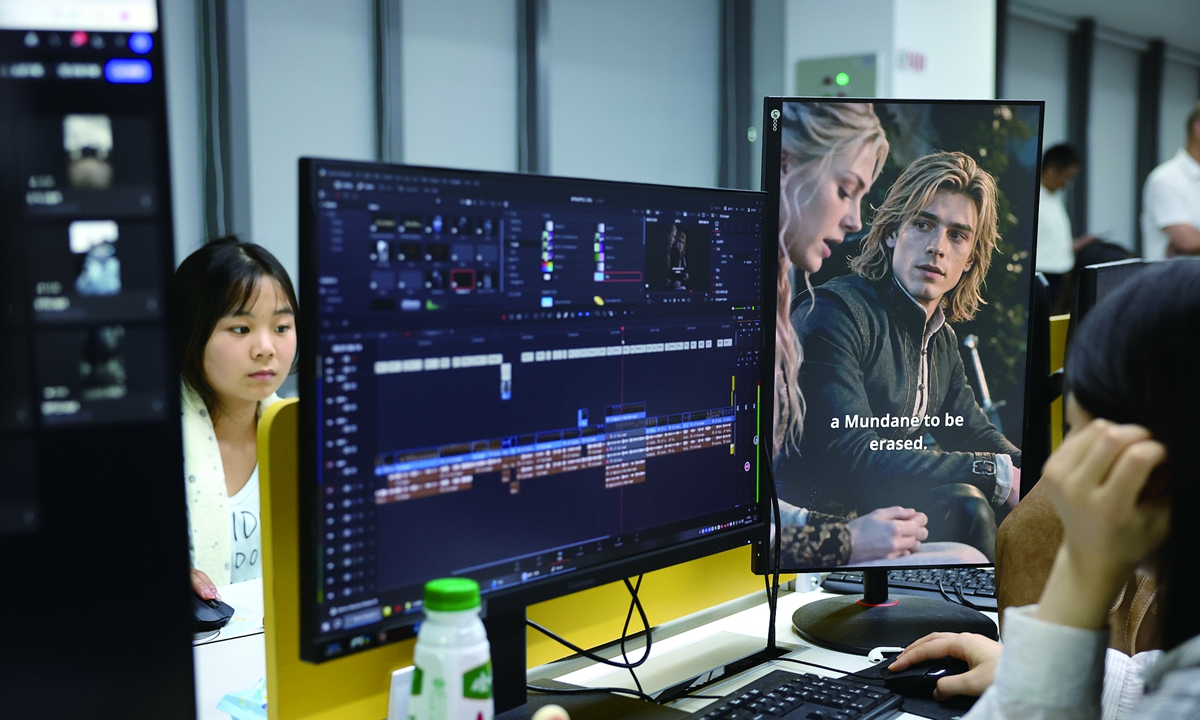
Open Douyin, the Chinese version of TikTok, and AI-generated short dramas are hard to miss.
The stories span almost every genre familiar to Chinese audiences, from fantasy and immortal cultivation to urban romance and period tales.
The biggest difference is that the actors, settings and even many of the visual elements are generated by artificial intelligence (AI).
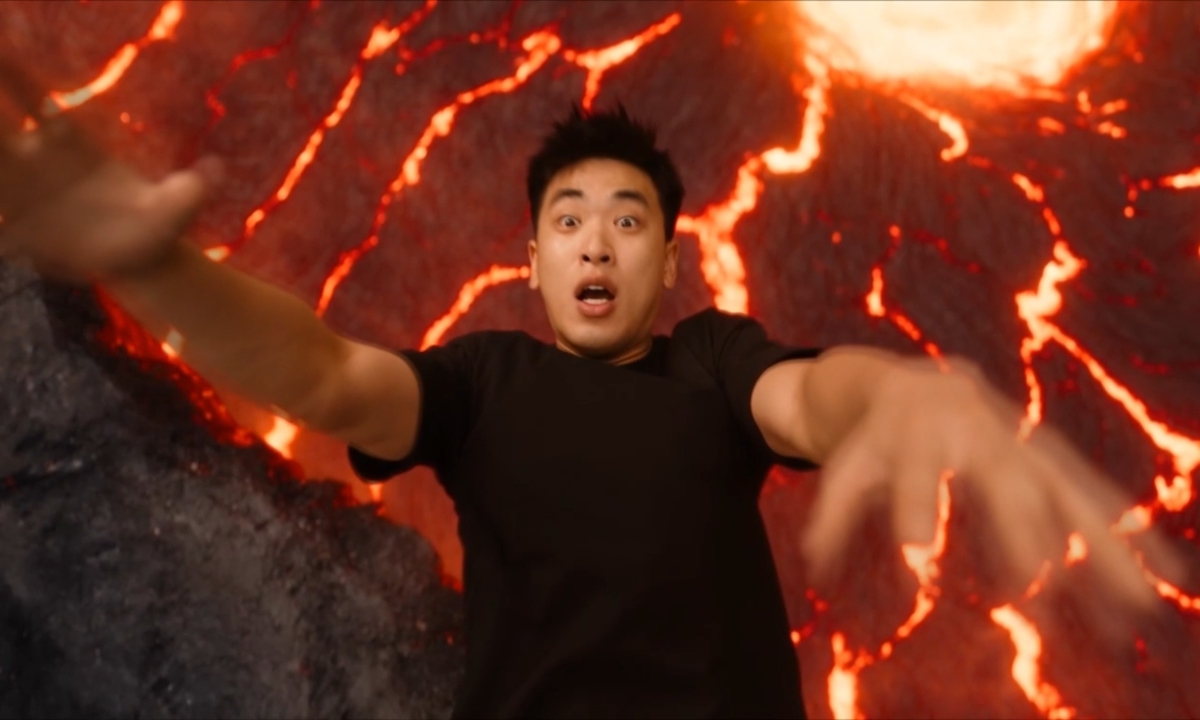
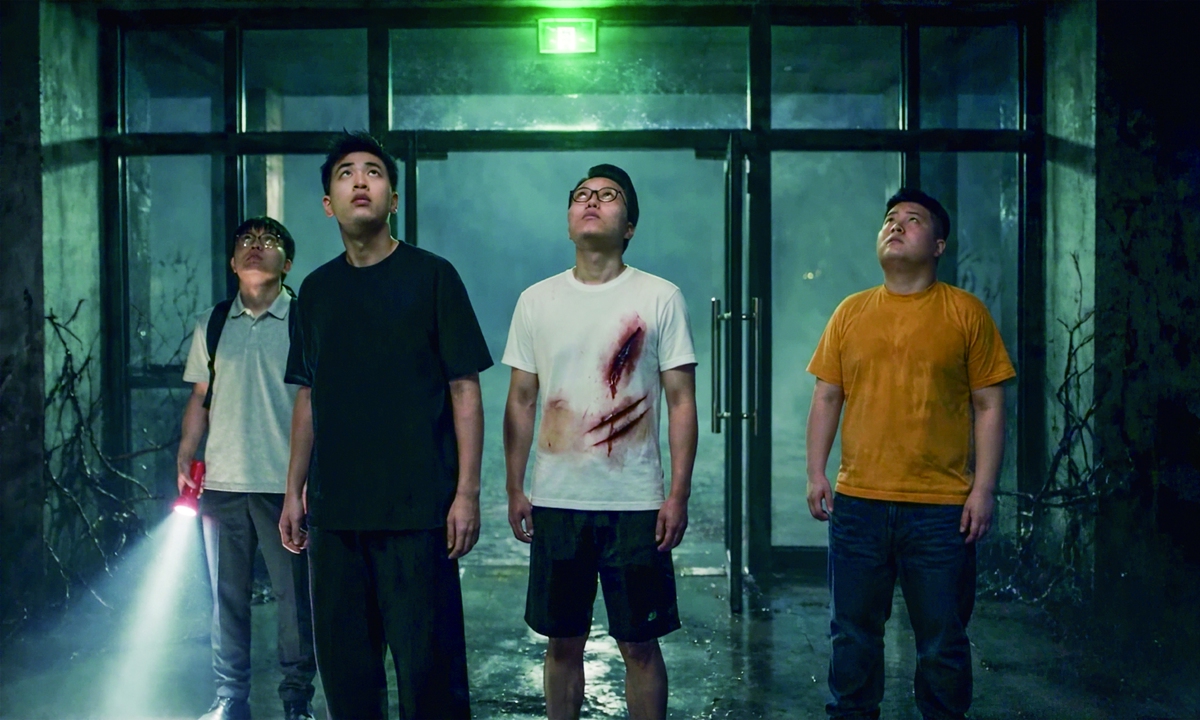
One of the latest hits is The Inverse Zone, an original mystery-thriller about monsters that has been dubbed an AI version of Stranger Things. The series has released three episodes so far, each receiving more than 1 million likes on Douyin.
Yet the team behind it consists of just three people, all born after 2000.
While Hollywood is still catching up with the short drama boom, China's short-drama industry is already moving into the AI era.
For many young creators, AI is not just another tool - it is a door that small teams could never have opened before.
"We've always wanted to make professional film and television content, with visual language, complete storytelling and a cinematic feel," Hu Hai, a member of the team behind The Inverse Zone, told the Global Times. "But the cost and barriers of live-action production were too high. Small teams had little chance to realize high-quality film and television projects."
As increasingly capable domestic AI models emerged, that door began to open. "The maturity of AI creative tools made us see new possibilities," Hu said.
The explosive growth of AI-generated short dramas is a double-edged sword: It opens doors for some, but leaves many in the industry uncertain about what comes next. Many actors who once benefited from the short-drama boom are now finding work increasingly scarce, with some turning to other professions. Meanwhile, the use of celebrities likenesses in AI-generated content (AIGC) has ignited a fresh wave of debate.
Where is the industry headed next? Global Times reporters spoke with AI creators, short-drama actors and industry experts about the opportunities and uncertainties ahead.
Lowering barriers
Hu studied directing and filmmaking in college. His team initially focused on short comedy videos, a field with relatively low production costs and less barriers to entry. But after years of producing this type of content, they eventually reached a creative plateau. That began to shift as more advanced AI tools came onto the scene.
To produce The Inverse Zone, the team used domestic video-generation models Seedance 2.0 and 2.5. The series took nearly two months to prepare, including world-building, character design and establishing a consistent visual style. "Seedance is the best in the world. It's extremely advanced. There's no model in Europe or the US that is more useful than it," Hu told the Global Times.
The technology does not mean production is effortless, however.
According to Hu, a typical episode costs around 4,000 to 5,000 yuan ($593-$741) to produce, while episodes involving large-scale scenes, complex special effects or demanding lighting and rendering can cost more than 10,000 yuan.
The team used AI for image generation, basic voice work and material rendering, while humans remained responsible for the script, character development, cinematography and post-production.
"The soul of the entire series is still controlled by people," Hu said. "All the key creative decisions are manually adjusted and repeatedly reviewed."
Ya Cen, operations head of AI video platform LibTV, told the Global Times that the AI short-drama ecosystem is now characterized by small teams, high productivity and strong individual styles. "The most direct value of AIGC is that it has lowered the geographic and financial barriers to film and television production," she added.
Actors in AI era
Yet the rise of AI short dramas is also creating new tensions.
AI-generated characters are now building fanbases, landing brand endorsements, and being described as the next generation of digital stars. At the same time, many celebrities including Taiwan actress Joey Wong have reportedly given permission for their younger likenesses to be used in AIGC.
The impact extends beyond celebrity likenesses. It is also being felt by people who once benefited from China's booming live-action short-drama industry.
The short-drama boom created opportunities for large numbers of actors, many of whom could quickly become recognizable faces. However, as AI-generated productions expand, some performers are finding fewer acting opportunities and turning to other professions.
Chongqing native Luo Xinyuan, 21, has experienced that shift firsthand.
She spent more than a year in Hengdian, East China's Zhejiang Province as a short-drama actress. Since May, she has worked at a scenic area playing Huang Rong, a character from a classic Chinese martial arts novel The Legend of the Condor Heroes.
"When short dramas were at their peak, there were lots of fast-paced, feel-good stories," Luo told the Global Times. "But that kind of content is difficult to sustain. Without richer and more meaningful stories, the pressure from AI short dramas will make things even harder."
For many short-drama actors, the disruption is likely to be structural rather than an immediate wholesale replacement, Zhang Peng, a cultural researcher and associate professor at Nanjing Normal University, told the Global Times. The question of celebrity likenesses may prove even more complicated.
Zhang warned that unrestricted authorization could raise concerns over control and revenue sharing. Without clearer rules, the technology could put further pressure on ordinary actors.
The next stage may not be a choice between humans and machines, but a new production model in which the two increasingly work together.
For creators such as Hu, that possibility is already here.
"AI has finally given young creators like us the opportunity to realize the film and television dreams we've had for years," he said.
。
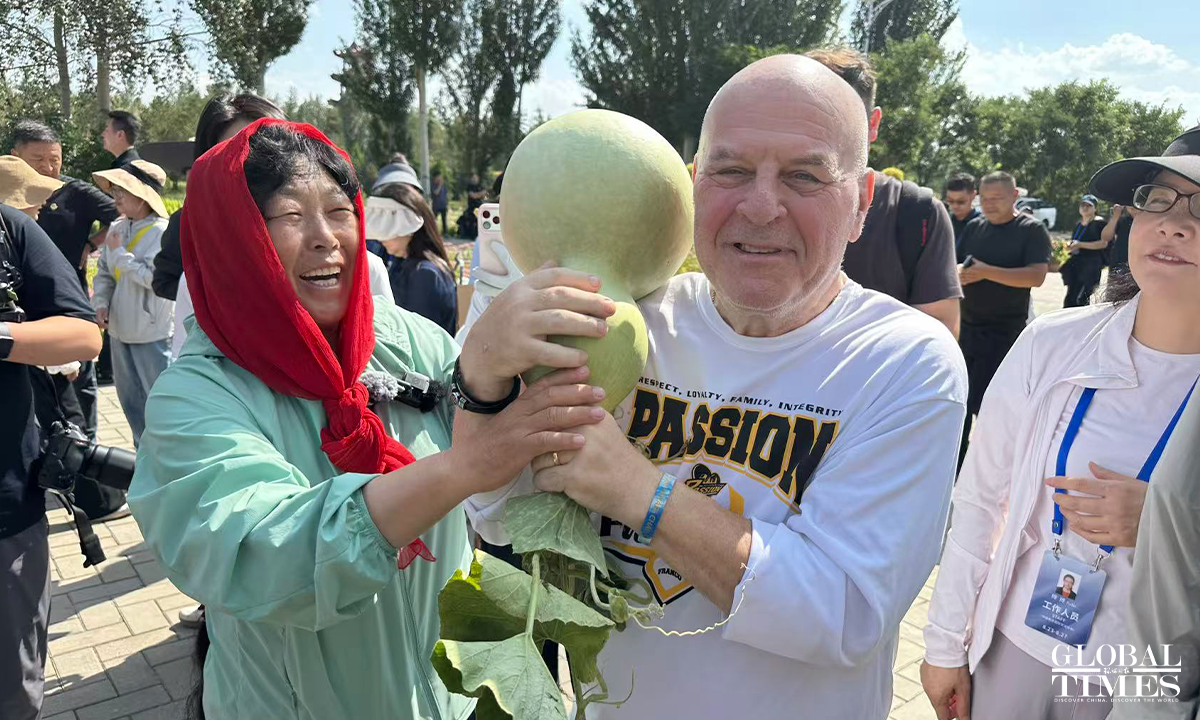
On Monday afternoon, American teacher Ronald Sakolsky visited the homeland of Chinese desert fighter Yin Yuzhen in Uxin Banner of Ordos, Inner Mongolia Autonomous Region. This was a place the American man had visited in 2000 and it has completely changed since then.
In 1999, Sakolsky, a teacher in a China-US education exchange program, was touched by a report on Yin and her husband's afforestation efforts in the harsh wilderness of Mu Us Desert, and raised $5,000 to support her green cause. During that visit, they took pictures - in front of the sunken pit where the Yin couple once resided and in the barren land with a finger-thin sapling they had just planted against a backdrop of dust and bare earth.
What has the $5,000 changed?
On Monday, they came to the Sakolsky forest - a permanent tribute honoring Sakolsky's early contribution to the region's ecological revival - and replicated the vintage pictures, standing in front of a pit that has long been abandoned and beside a newly planted sapling. This time, however, there are bushes and trees in the background.
This contrast not only witnessed their friendship across time and the Pacific Ocean, but also showcased a promise Yin has kept for 27 years and a green dream that has been made possible through generations of joint unwavering efforts from Yin, her husband and countless other sand fighters.
Homecoming with family cooking
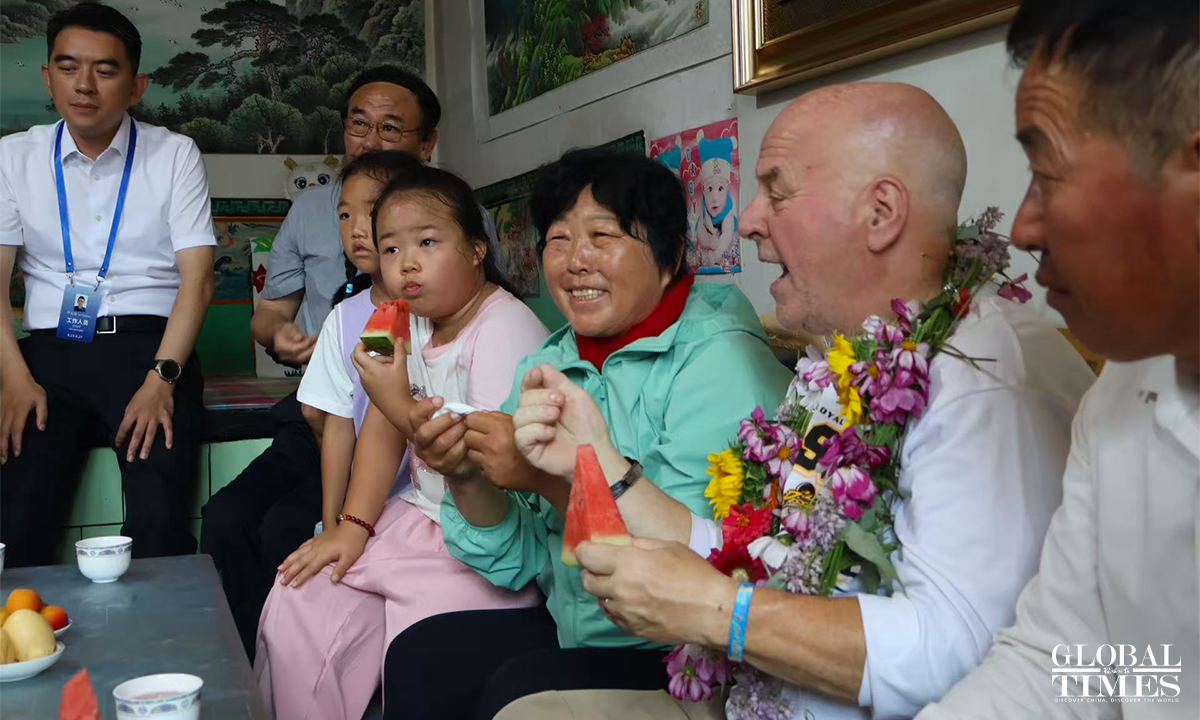
Yin hosted Sakolsky on Monday at her home, filling the air with the aroma of home-cooked meals during their long-awaited reunion. Watermelons were served along with other fresh fruits and vegetables, all harvested locally. Yin told the Global Times earlier that she learned the English word "more" to persuade him to eat more.
In 1999, Yin had few options for showing her hospitality, so she cooked a bowl of plain noodles for Sakolsky. Now, the harsh wasteland has transformed into a vibrant green oasis, thanks to unwavering afforestation efforts.
In the courtyard, the Global Times reporter saw Yin grinning from ear to ear with pride as she introduced the produce from the farmland - green pepper longer than a palm, a bottle gourd even bigger than Yin's head, and bags of foxtail millet packaged with the assistance of Yin's grandchildren, who are proud of the family's generations of commitment to green causes.
During a tour of Yin's home, Sakolsky was impressed by the beautiful house with its green courtyard, saying "You deserve every centimeter of this house." Throughout the visit, he repeatedly praised Yin's hands, which the desert fighter and model worker used to change both the land and her own life through arduous work.
The $5,000 Sakolsky donated in 1999 was equivalent to three years' income for Yin's entire family at the time. Today, that money has grown into more than 50,000 trees.
But Yin's journey did not stop there. Over the following decades, with the support of China's growing ecological restoration policies — including subsidies for afforestation and compensation for forest managers — she transformed the barren land into a productive family forest farm. Her success has inspired many others in the region to take up tree planting and sand control, transforming what was once a desperate struggle into a sustainable livelihood.
From the sandy hollow where the Yin couple lived in in 1985 and the earth hut they resided in until 1993, to the solid brick house Sakolsky saw when he last visited, and the two-story house the big family now lives in, the change in living environment is a clear example of ecological dividends.
Uxin Banner lies in the heartland of the Mu Us Desert. The desertification rate was over 90 percent in the 1950s and forestation coverage was merely 7.2 percent as of 1980. Now, the forestation rate has increased to 33 percent, while plantation coverage has expanded to 85 percent, per official data.
Carry on the greenness, kindness
This miracle would have been impossible without numerous people like Yin, long-term systematic planning and scientific governance.
Chen Ziliang, an expert from the local forestry and grassland bureau, said that Mu Us Desert's sand‑control journey has evolved from collective afforestation to contract desert‑reclamation, moving beyond the simple goal of "keeping trees alive" to restoring vegetation based on water‑resource conditions.
Putting the idea of "lucid waters and lush mountains are invaluable assets" into practice, Uxin Banner no longer views "greenness" and "growth" as an either‑or proposition. On restored sandy lands, the under‑forest economy, eco‑agriculture and eco‑tourism have flourished. Sand‑fixing shrubs are now processed into animal feed and biomass fuel, and local authorities are exploring photovoltaic‑powered desert control, the Global Times learned.
Sand control is no longer just about keeping sand away; it's a development approach that guarantees a greener and better living environment alongside a booming economy and increasing incomes.
On Monday afternoon, when Sakolsky finally stepped into the forest named after him, this American teacher witnessed the Chinese woman's perseverance and commitment to her promises. The $5,000 donated without expectations has grown into a thriving forest of around 50,000 trees.
"A promise is a promise. Ms. Yin fulfilled her promise," Sakolsky said. After 27 years, the wasteland is green, and Sakolsky and Yin are "brother and sister."
"This is the answer to how we guide young people: We must teach them love and perseverance. We need to show young people photos of Ms. Yin planting trees, digging the soil with her bare hands," Sakolsky remarked while packing a jar of sand. He said he planned to bring it back to the US, telling his grandchildren it is not just a jar of sand, but "a jar of love."
Sakolsky told the Global Times earlier that the younger generation only knows about the dust-covered landscape from photos and stories of the elderly. It is important to tell them how the greenness is achieved, and how every single person can contribute to making an extensive forest in the harshest environment.
"I see where China and America can work together. I see it, so I will not quit. She [Yin] never quit. 'Quit' is not in her vocabulary," Sakolsky said with emotion on Monday.
"Chinese and Americans can be family. We can get over the differences if we focus on the similarities... If we focus on our similarities and not our differences, we can solve the problems."
At the end of Monday's schedule, Yin and Sakolsky planted another sapling together, just as they did about three decades ago, but in a completely different landscape.
This new sapling carries on the story of not only greenness through generations of joint efforts, but also kindness across the Pacific Ocean.
。
Current article:http://0lgfz.cheshenzhuaduanza.buzz/list_5ptk8/gak7fh8.html
Published on:16:54:05


